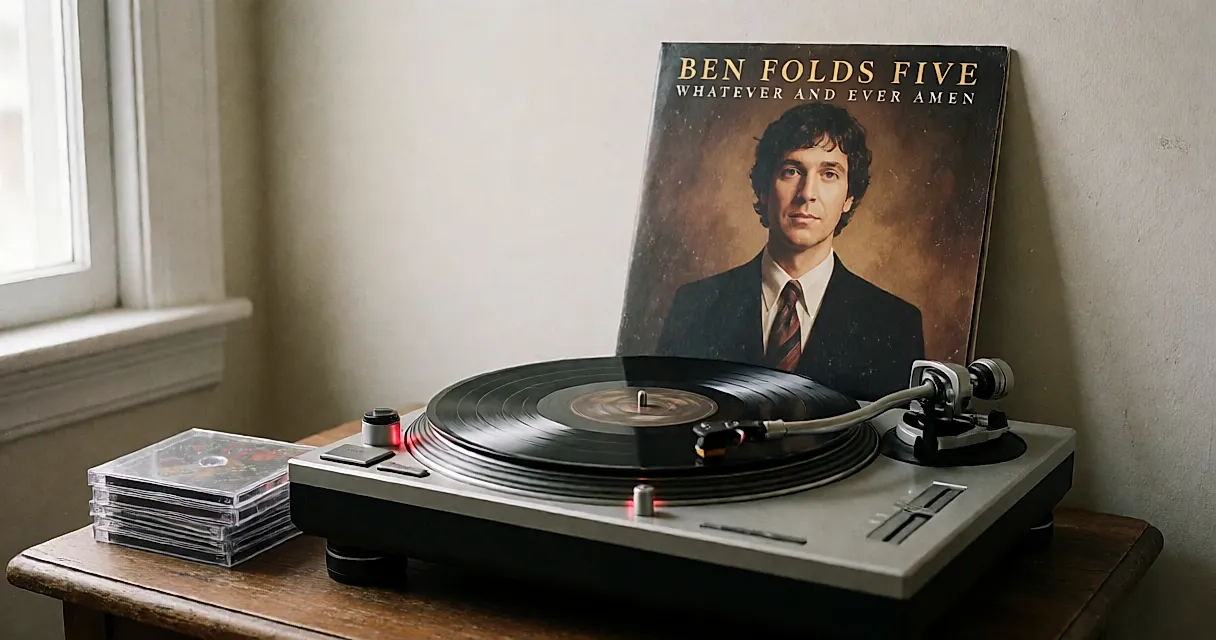
Look for the guitar on the back of Whatever and Ever Amen and you won't find one. The credits run piano, bass, drums, then a cello, two violins and a Hammond organ — as if the trio had made up on top what it refused on six strings. Three players, no guitarist, and still a full sound: an imbalance doing the work of a method.
Two ways into the room
Worth restating something the reunion announcements tend to smooth over: Ben Folds Five split in 2000, then reformed in the early 2010s for one record — The Sound of the Life of the Mind — and a tour. So this isn't a first comeback but a third chapter. The distinction matters: a trio that has already tested its own reunion doesn't come back with the innocence of a band resurfacing after twenty years of silence.
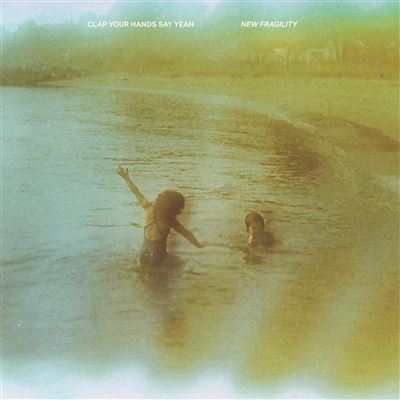
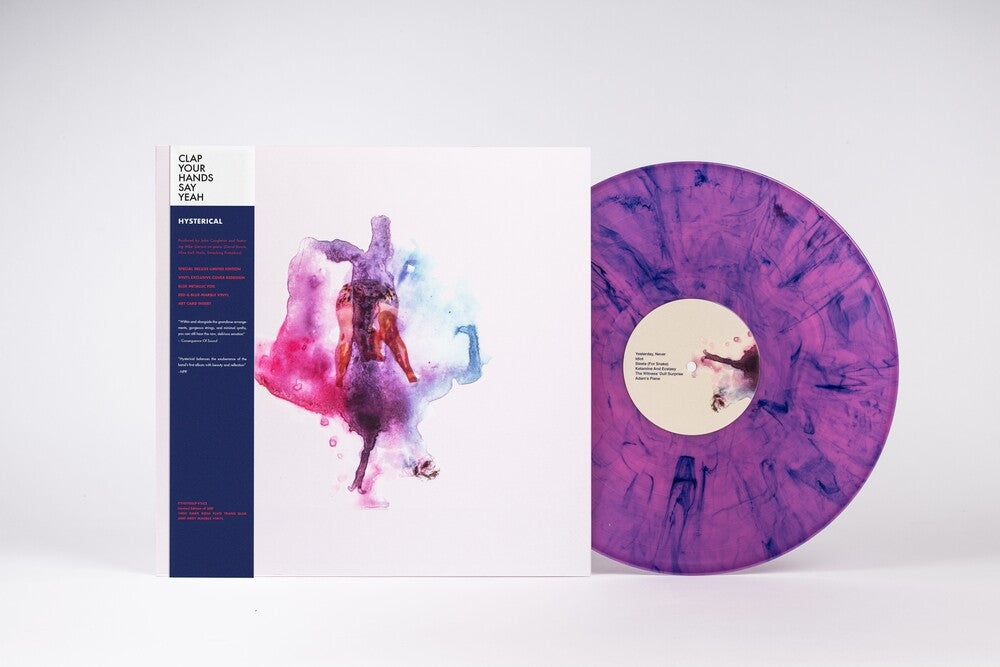
Clap Your Hands Say Yeah, by contrast, never really went away. The name carried on, steered by Alec Ounsworth, through Some Loud Thunder in 2007, Hysterical in 2011 and New Fragility in 2021. The difference is structural rather than cosmetic: three musicians who have to agree a shared diary on one side; on the other, a shopfront older than the line-up currently living in it.
Dates, venues, ticket prices: none of that was in the material available when this was written, for either act. We're not going to invent it. An announced tour is not a documented tour.
What the credits say
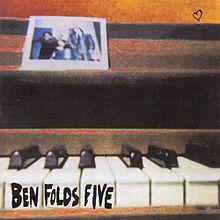
Ben Folds Five's first album, out in 1995 on Passenger/Caroline, carries a credit that counts: Caleb Southern on production. A guitarless trio isn't an arrangement quirk, it's a division of labour. The piano takes the harmonic space and much of the melodic space that two instruments normally share; Robert Sledge on bass and Darren Jessee on drums hold the rest. The instrumentation is verifiable, and minimal: piano, bass, drums.
Whatever and Ever Amen, released on 18 March 1997 on 550 Music, pushes the logic further. Ben Folds and Caleb Southern share production, Andy Wallace handles mixing — a name more often found around saturated rock than a piano trio. The strings are arranged and conducted by John Mark Painter, with John Catchings on cello, David Davidson and Christian Teal on violins; Caleb Southern takes the Hammond organ. And in the middle of it all, Brick, the piano ballad that carried the band far beyond its original audience. The contrast with the overdub-heavy productions of the same period is measured by what isn't there: no guitar.
With Clap Your Hands Say Yeah the documentary uncertainty is greater, and it should be said plainly: no available source details the studio or the budget behind the 2005 debut. The record is generally understood to have been self-produced, pressed at the band's own expense and handed out by hand before being picked up; under what technical conditions is not known. That grey area is part of the story. The myth of the record "thrown together" usually rests on deliberately thin credits.
What a record costs
A tour and an album are not financed the same way. Live work brings money in — fees, ticket sales, merch — against fixed costs you can see coming: the van, hotel nights, crew. The record brings in nothing until everything has been spent. Studio, mixing, mastering, pressing, artwork, promotion: the outlay comes first, and nothing guarantees the income will follow.
This is where the two paths genuinely part. In 2005, entry for Clap Your Hands Say Yeah cost very little: self-production, a modest pressing, hand-to-hand distribution. That low cost wasn't a logistical footnote, it was the gesture itself — the release worked as a calling card, not a financial product. Twenty years on, the question is no longer what it costs to play together, but what it costs to make a durable object alongside.
Studio rates we won't quote: they vary tenfold by city, by number of days, by who's in the room. The logic, though, barely moves. A tour pays itself back; an album is a bet. When a generation of listeners gets a tour where it was expecting a record, that's the asymmetry it's looking at without naming.
Three checks before you click
- A tour announcement says nothing about an album, and an album announcement says nothing about gigs. Two separate calendars, often run by two separate teams.
- On a record billed as "new", check whether it's unreleased recordings, a compilation or session archives. The wording is nearly always there, just rarely in large type.
- The label and the producer tell you more than the first line of the press release. It's often the only place you learn who paid for what.
Listen
Ben Folds Five's three 1990s albums are usually on the main streaming services, which is enough to check the chronology without buying anything. For the physical object, budget around £17 to £26 for a new vinyl copy, depending on edition and country of pressing, and £7 to £13 for a secondhand CD at an independent record shop — condition obviously moves the figure.
For Clap Your Hands Say Yeah, Some Loud Thunder and New Fragility remain useful entry points. No new album was documented at the time of writing; quoting a vinyl run, a limited edition or a price would risk sending you to a page that doesn't exist.
One question remains, and it isn't rhetorical: when a tour pays for itself and an album is a bet, what does that say about the value we place on recording today? Until there's an answer, two records to go back to: Whatever and Ever Amen and New Fragility.
Credits
Credits for Whatever and Ever Amen — Ben Folds Five (1997):
- Instruments: Norwood Cheek (synthesizer); Ben Folds (electric piano); Ben Folds (melodica); Ben Folds (piano); Darren Jessee (drums); Darren Jessee (percussion); Robert Sledge (bass); Robert Sledge (double bass) …
- Vocals: Ben Folds (lead vocal); Darren Jessee (backing vocals); Robert Sledge (backing vocals)
- Production: Ben Folds; Caleb Southern
- Mixing: Andy Wallace
Source: MusicBrainz — accessed 22 October 2026.
Sources
- Credits for Whatever and Ever Amen, 550 Music, 1997 (back cover).
Comments
Your opinion matters: rate the article, react and reply to comments.
Comments are moderated; AI-assisted comments are flagged. Text emoticons (8-), :-), <3…) are automatically shown as images.