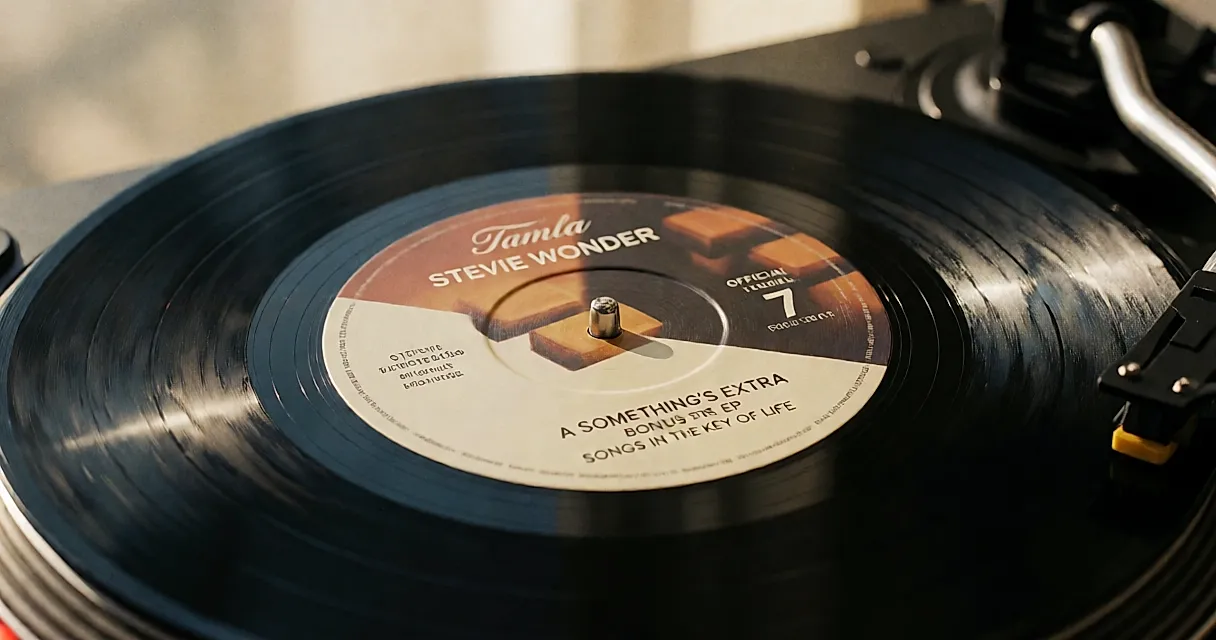
On the label of the first US pressing, two catalogue references answer each other: the double album’s and that of the small disc slipped inside the sleeve. One side reads T13-340C2; the other is marked as a supplement. Fifty years on, that small detail of label printing tells you everything about the problem with anniversary reissues: before you add anything, look at what the record already contained.
The supplement was already part of the package
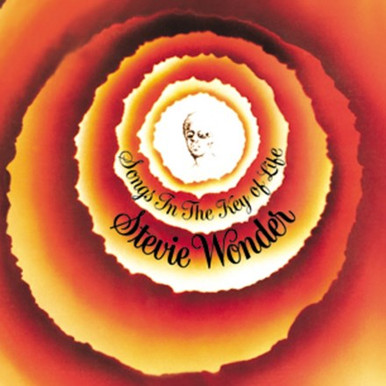
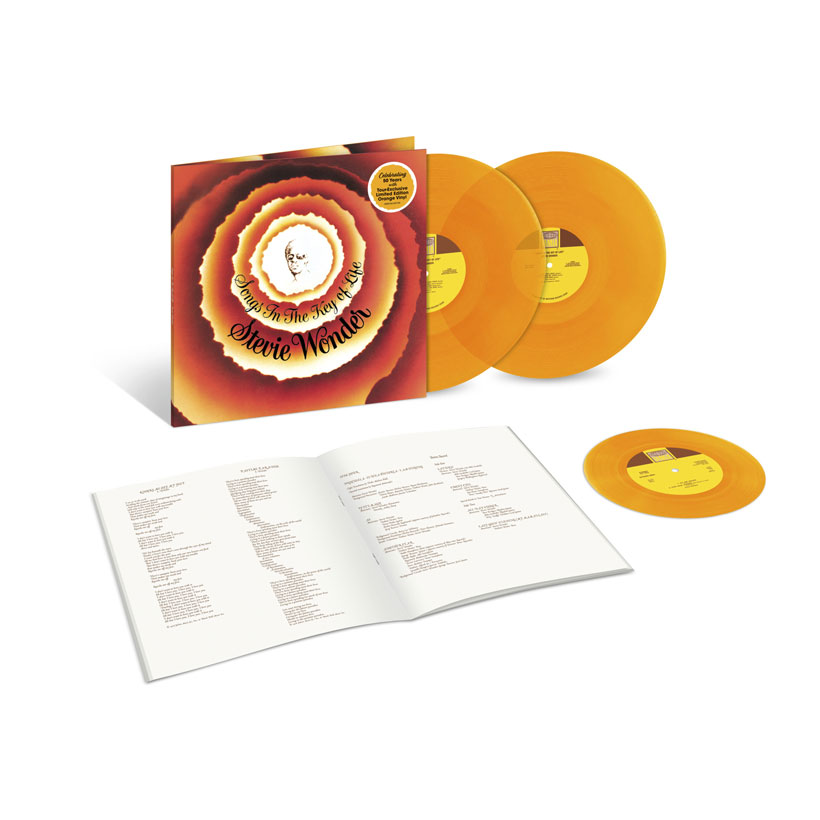
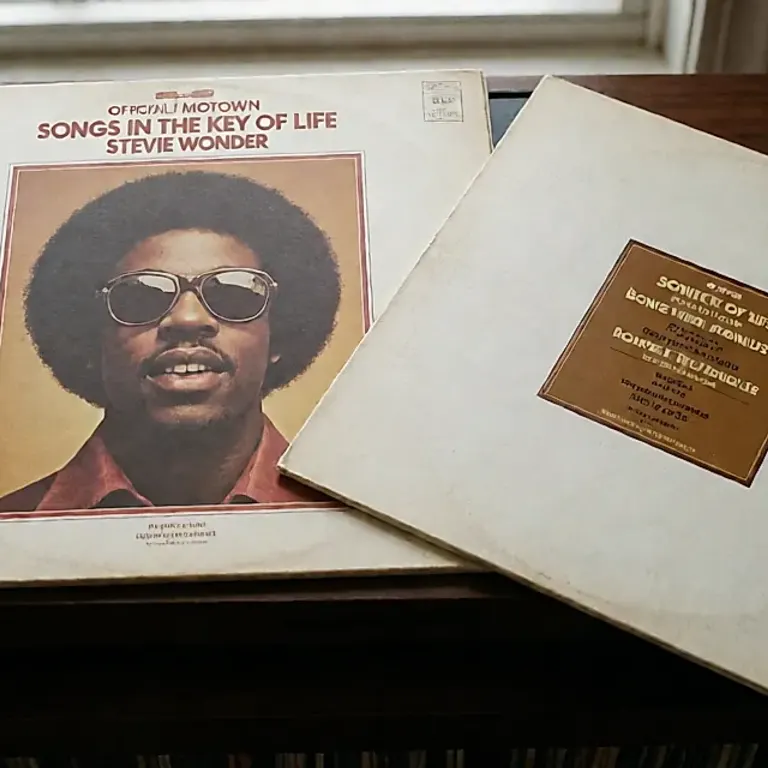
On 28 September 1976, Tamla released Songs in the Key of Life as T13-340C2: two LPs plus a 7-inch called A Something’s Extra, which added four tracks — ‘Saturn’, ‘Ebony Eyes’, ‘All Day Sucker’ and ‘Easy Goin’ Evening (My Mama’s Call)’. This is not a double album like other double albums, and the label says so before the stylus has even touched the first groove.
On the back of the sleeve, Stevie Wonder is credited with production, Malcolm Cecil as associate producer, and the list of players runs over whole lines: Eddie “Bongo” Brown on percussion, Ben Bridges on guitar, Greg Phillinganes on keyboards, Raymond Pounds on drums. Further down, the voices: Shirley Brewer, Michael Gray, Josie James, Artece May, Renee Hardaway, George Benson credited on backing vocals, and even the West Angeles Church of God in Christ Mass Choir. All of this is packed on to a piece of cardboard — and that is exactly where the trouble starts.
What, then, can a 50th-anniversary edition add? A new master, first, provided we agree on the word. Remastering means reworking the cut from the existing stereo mix; remixing means going back to the multi-track tapes and repositioning the instruments. The first clarifies or hardens; the second moves things around. Then come alternate takes, session photos, the booklet. On an album as dense as this, the line between context and filler is thin.
Then there is the habit of folding the 7-inch into the run of the double album. It is convenient for platforms and false to history: those four tracks came out with the record on a separate piece of vinyl, and slipping them into the main sequence amounts to rewriting the 1976 running order. A good reissue starts by respecting that order; it adds afterwards, not before.
Wish You Were Here and pinning down the reissue
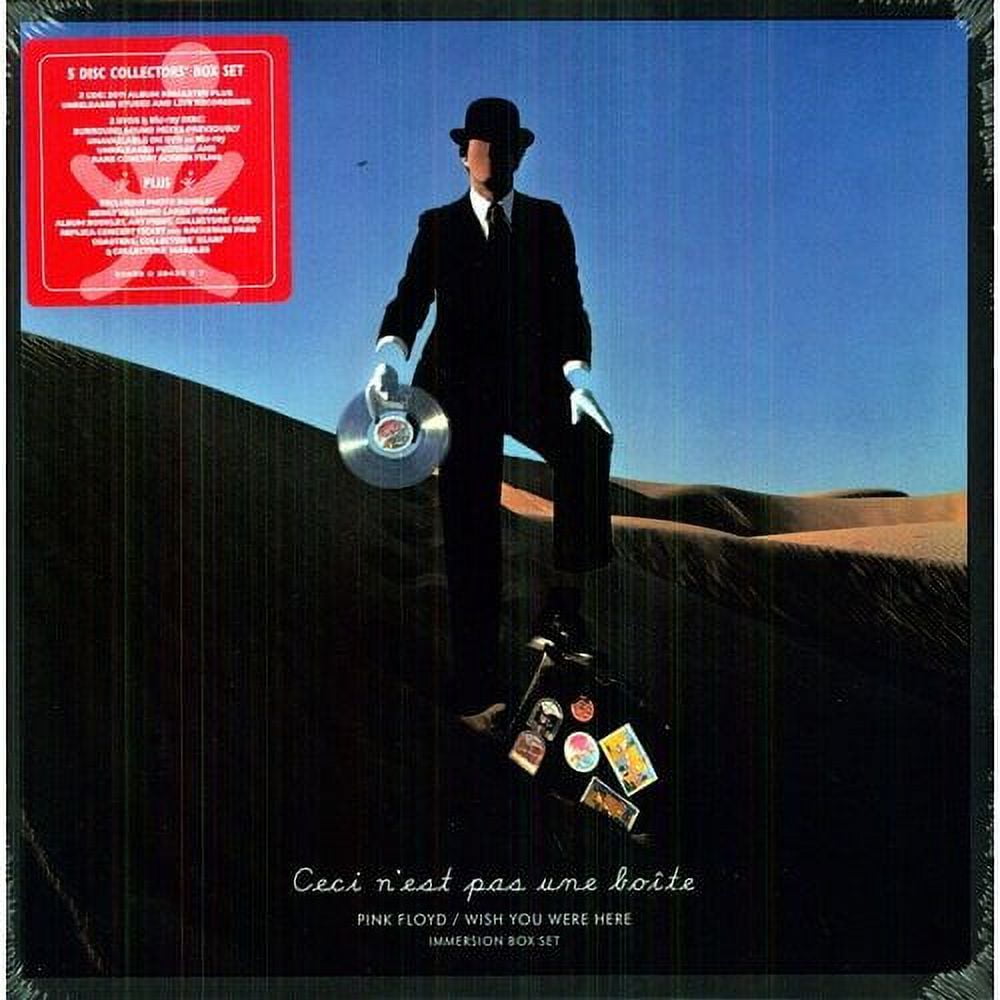
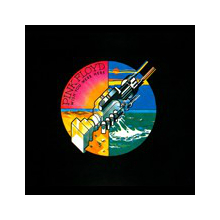
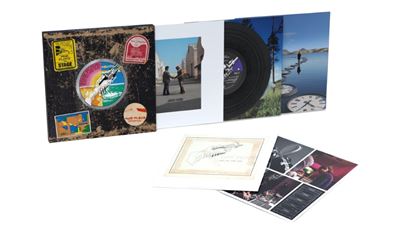
The other model comes from Pink Floyd. With Wish You Were Here, judging an anniversary edition means identifying the exact reissue, the year and the list of takes: without those markers, you cannot tell whether you are holding a document or mere packaging. The word that matters is ‘versions’. An alternate take is not one more song; it is a stage in the manufacturing process. One question remains that no sticker can settle: does the edition help you understand how the record was made, or does it pile up formats to justify the price?
What an anniversary shifts
An anniversary, at bottom, no longer sells the album: it sells the time around it. For Songs in the Key of Life, the argument rests on the density of an already vast work and on the chance to recover the exact object — the 7-inch, perhaps a booklet, a new cut. For Wish You Were Here, it rests on depth of field: the record is well known, and a documented edition can help reconstruct the chain, provided the reissue and its contents are precisely identified. In both cases, the offer is aimed at someone who already owns the record, or can stream it. They are not paying to discover the songs; they are paying for another way into their making.
The risk is exactly there: document or packaging. The number of discs is not a criterion — ten versions of the same track teach nothing if you do not know what changes between them. One disc of takes is enough when it is documented: date, studio, musicians, why it was abandoned. And you have to say what you do not know: box-set notes do not always specify whether the master is new, whether it comes from a new digitisation of the tapes or reuses an earlier edition. It is less spectacular than a sticker, but it is what you are buying.
Before you reach for your card, three checks. The nature of the master: new, repressed, or a simple repackaging of the same file. The actual list of takes and mixes, with dates — no dates, no marker. The format, finally: a Blu-ray and a vinyl record do not carry the same information, and a download may be enough if you are only after the extra tracks. If the listing stays silent, wait for a clearer description, or ask the record shop: they often have the answer.
Listen
To hear the 1976 order, you need the double LP with the 7-inch A Something’s Extra, which preserves the separation between the album and its supplement. On the major streaming services (Spotify, Deezer, Qobuz, for example), the presentation can vary: the 7-inch is sometimes folded into the sequence, sometimes offered separately, with inconsistent labelling. A new vinyl copy will cost around £30–55 depending on the pressing and the import; on CD, roughly £13–22. When buying, check that the 7-inch and the booklet are there before you pay, not after.
For Wish You Were Here, a new single LP often costs around £22–30; box sets, by contrast, run well over £85. An independent record shop remains safer than a marketplace for checking an exact reference, especially with a box set. And if you want to understand how the record was made first without buying anything, go back to ‘Shine On You Crazy Diamond’ in its original order, then look for documented alternate versions: that is where the difference between a take and a master becomes concrete. As for the 1976 7-inch, it can also be listened to on its own, after the double album, as a postscript rather than an encore. One question remains for you: is an anniversary reissue made to make you listen to the record again, or only to make you buy it again?
Credits
Credits for Songs in the Key of Life — Stevie Wonder (1976):
- Instruments: Eddie “Bongo” Brown (percussion); Stevie Wonder (drums); Stevie Wonder (synthesiser); Stevie Wonder (Rhodes piano); Stevie Wonder (clavinet); Stevie Wonder (synth bass); Stevie Wonder (percussion); Stevie Wonder (keyboards) …
- Vocals: Stevie Wonder (lead vocals); Stevie Wonder (backing vocals); Shirley Brewer (backing vocals); Michael Gray (backing vocals); Josie James (backing vocals); Artece May (backing vocals); Mary Lee Whitney (backing vocals); George Benson (backing vocals) …
- Performance: Wonderlove; Stevie Wonder
- Production: Stevie Wonder
- Arrangements: Stevie Wonder
- Programming: Charles Brewer; John Fischbach; Stevie Wonder
Source: MusicBrainz — consulted 22 October 2026.



Comments
Your opinion matters: rate the article, react and reply to comments.
Comments are moderated; AI-assisted comments are flagged. Text emoticons (8-), :-), <3…) are automatically shown as images.